
THE OCTOBER BREAKTHROUGH
HOW A ONE-LINE COPY TURNED INTO A 3-MILLION-POUND CAMPAIGN
BRAND CASE CONTEXT
The selected case involves a brand that represents itself as the first micro-investment-friendly, money-saving platform focusing on wealth multiplication through non-binding, multi-scale savings in gold. The brand had previously collaborated with Lab1K as a media growth agency for its initial pre-market activation, including branding, brand development, and value proposition shaping, and later, for its initial kick-off and digital marketing activation strategy development between 2023 and 2024.
In early October 2025, the collaboration between Lab1K and the brand was re-activated once more. At first glance, Lab1K decided to set expectations with the brand leadership team by providing a strategic overview that comprises:
- A Comprehensive external situational analysis through macro- and micro-environmental analysis frameworks;
- Key external conclusions that would shape the format of key external strategic directives;
- A deep-dive market competitiveness analysis to fill the gaps in the macro-environmental analysis;
- Key micro-environmental strategic conclusions that include the current brand positioning and direct its next steps on strategic and tactical levels; and
- Key strategic targets and commercial objectives covering (a) the timeframe of Q4 2025 and extending to cover S1 2026 as well.
BRAND SITUATIONAL ANALYSIS BREAKDOWN
KEY METRICS & OBSERVATIONS
Based on entries generated by a PESTLE, market competitiveness, and initial brand metric analyses, the following was observed:
1. Value Proposition & Positioning
The brand’s offering is positioned right at the most critical juncture of the socio-economic and macro-economic distress based on the urgent financial pain points, and hence, the loss of purchasing power pushing toward micro-saving in a stable-to-growing asset. While the digital space is attracting more traction, the brand emerges as a response to urgent economic need, cultural legitimacy, and digital readiness thanks to convenience and its non-binding nature.
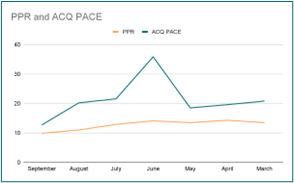
Although the brand value proposition should align with the current market appetite, the brand is finding troubles due to inconsistency in new customer acquisition propagation with an average PPR (payment penetration rate) of 12.88% regardless of the acquisition curve velocity, which directly relates to low quality of propagation and even a lower quality of customer acquisition.
2. Message & Brand Equity
The brand’s message is attributed a huge focus in its market as three out of Porter’s five key forces in the market are associated with the message architecture and the brand positioning. Pushing the right message to the right audience is key to differentiating the brand value proposition. The focus on micro-saving should be essential to push the brand away from the forced direct competition with indirect competitors in the Egyptian financial service markets, such as banks, ROSCA, etc.
In fact, the brand competitiveness shall be strongly influenced by its positioning among customers, competitors, and suppliers, which attributes specific importance to the brand’s messaging architecture.
Our general analysis of the brand messaging value and existing equity in its digital and non-digital ecosystems demonstrated the following:
- Messaging Inconsistency: the brand messaging has been revolving around generating cheap engagement and clicks rather than clarifying the brand value proposition, and hence, the key offering is mispositioned as an “investment tool” rather than a “micro-saving tool”, automatically placing the brand as a direct competitor with banking products, ROSCA, and money-lending institutions.
- Failure of Vertical & Horizontal Expansion: the brand should first optimize the quality of engagement with the existing users (underutilized pool) then move to unlock new growth segments (underserved pool) to pivot around the impending wall of rising costs and diminishing returns.
- Lacking Growth Engine: the brand is celebrating endorsements rather than revenue, which means the actual value of each new registered user is significantly lower than their estimated value.
The tactical campaigns, mostly on digital media, have been reinforcing the wrong message of “investment-driven” value, promising excitement, profitability, and fast returns. This tone appeals to individuals seeking speculative opportunities (absolutely not the winning segment for the brand), while our product is built on the opposite psychological anchor: trust, stability, and long-term savings security. This fundamental misalignment creates friction at every layer of the funnel, from ad clicks to app engagement and retention promising a fake upfront value. In what concerns the key insights into this situation, it is safe to conclude that the semantic field generated by the majority of copies and content developed by the brand creates an expectation of active financial speculation instead of stability in saving.
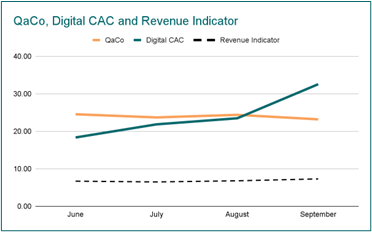
The aforementioned insights were translated into the comparison between the patterns of the acquisition quality coefficient (QaCo), digital consumer acquisition cost (Digital CAC), and the brand’s revenue indicators.*
As clearly demonstrated in the corresponding graph, while the revenue indicator and QaCo were nearly stagnant in pattern, CAC was raised suspiciously in September 2025, which demonstrates the issue in the underlying pattern of newly acquired customers.
Both, wording and visualization, are attracting individuals with misaligned intentions on social media and tactical campaigns.
The non-binding nature of the brand offering increases the brand’s leverage over buyers only if positioned correctly. Additionally, Digital competitors offering micro-saving/ micro-investment in the brand’s current and potential markets are currently limited.
Broader competition through portfolio diversification is intensifying through micro-saving and micro-investment friendly products, including providers from FinTech, Banks, and Telecoms. The brand should quickly diversify after establishing key targets in the current market(s).
3. Logistics & Supply Chain
Key providers include bullion providers, vaulting/custody services, cloud/tech providers, and payment processors. Suppliers have moderate leverage over the supply chain model of Taiseer.
Diversification should be recommended between national and independent providers for optimal security.
4. Acquisition Experience
In what concerns the brand’s new user acquisition strategy (horizontal expansion), our analysis underlined the presence of three key gaps hindering the brand growth, including (a) wording and message development, (b) visual and conceptual framing, and (c) wrong behavior reinforcement.
- The language used across headlines, event material, ad copy, and hashtags employs investment-oriented vocabulary; terms such as profit, gain, return, value increase, and gold opportunity. These phrases stimulate a “trader mindset”, not a “saver mindset”.
- Creative direction reinforces the same speculative narrative. Visuals often emphasize wealth imagery (gold bars, money stacks, profit graphs) rather than trust signals (security, consistency, simplicity). The creative hooks lean on gain instead of growth, return instead of reliability.
- The brand messaging currently appeals to individuals seeking “investment opportunities”, promising fast gains and high returns. However, the actual product is positioned around long-term savings security, a fundamentally different psychological trigger.
KEY FINDINGS & STRATEGIC DIRECTIVES
Based on the Brand Situational Analysis and the brand’s short-term objectives (3-6 months), the strategic directives aim to correct the fundamental misalignment between the brand’s product (micro-saving security) and its current market messaging (investment speculation).
1. Core Positioning & Messaging Correction
- Shifting Core Value Proposition
The brand communication must reposition its value from an “investment tool” to a “micro-saving” tool.
The current “investment” message attracts speculative users, leading to low Quality of Acquisition Coefficient (QaCo) and high Digital Customer Acquisition Cost (Digital CAC). The product’s actual psychological anchor is trust, stability, and long-term security.
- Refining Messaging Architecture
The brand must focus its vocabulary and content around stability, security, consistency, simplicity, growth, and reliability to eliminate “trader mindset” language such as profit, gain, return, value increase, or opportunity.
As demonstrated earlier, messaging inconsistency is mispositioning the brand as a direct competitor with banks and high-return financial products, obscuring its unique micro-saving value proposition.
- Pivot in Creative Direction
The brand should consider shifting visual emphasis from wealth imagery (gold bars, money stacks, profit graphs) to trust signals, simplicity, and consistent growth. Focus on “growth” and “reliability” over “gain” and “return”.
2. Acquisition Strategy Optimization
To achieve sustainable growth, the brand must shift its focus from sheer velocity to the quality of propagation.
The current Payment Penetration Rate (PPR) of 12.88% signals a fundamental misalignment in the funnel, where high acquisition numbers are undermined by low-quality engagement. Instead of “celebrating endorsements” without a corresponding lift in revenue, the strategy should prioritize existing user engagement, building a robust growth engine that extracts value from the current pool before pursuing aggressive expansion.
The aforementioned approach is clearly represented by the heterogeneous patterns between acquisition rates (conversion from advertisements), PPR, and total paying users’ coefficient.*
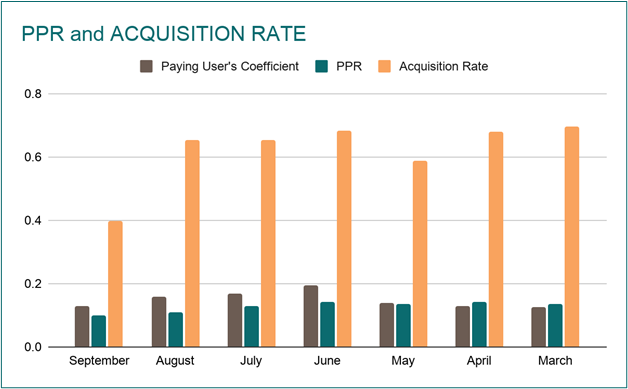
PPR reflects the depth of active users’ engagement with the brand’s value proposition.
The paying user’s coefficient reflects monetization depth across the entire user base reflecting a targeting efficiency of 3.41% (active weight).
The heterogeneous dynamics between the three metrics over Q2 and Q3 when compared with the MoM total users’ dynamic (confidential data) and the +61.4% in total MoM registered customers’ dynamic, reflects that the brand is attracting the wrong audience regardless of total revenue increase/decrease.
The aforementioned necessitates the optimization of existing user base value through increasing the amount of transactions, their value, and the number of engaged customers (vertical expansion) before migrating to new segments (horizontal expansion).
3. Long-Term Growth & Diversification
Once the existing user base is optimized, the strategy should shift toward unlocking new growth segments to bypass the impending wall of rising acquisition costs and diminishing returns, specifically addressing the CAC spike observed in September 2025.
It is critical to correct any failures in vertical expansion before pursuing horizontal growth to ensure a stable foundation. To maintain a competitive edge against fintechs, banks, and telecoms, the brand must prioritize market diversification, establishing firm targets in current territories while expanding into new products that leverage its unique, non-binding market position.
Supporting this growth requires a focus on logistics security, where diversifying supply chain providers, such as bullion and vaulting services, between national and independent sources will safeguard operations and moderate supplier leverage.
CUSTOMER ACQUISITION STRATEGY
Shaping a strategy for customer acquisition or market penetration is about choosing between getting new names on the books or getting more out of the names you already have.
Think of it like a party: acquisition is about inviting new guests to the house; penetration is about making sure the people already there are having such a good time that they keep on buying.
Here’s a golden trick to succeed in delving deeper into the PPR:
Keep the CAC as low as possible and the LTV as high as possible.
THE QUALITY VS VELOCITY DILEMMA
When Customer Acquisition Cost (CAC) is low, but PPR is also low, “cheap” leads become actually expensive. The brand is likely attracting users through high-velocity channels who have no intention of transacting.
Although LTVs are extremely hard to predict and calculate, performance marketing demonstrates that some leading KPIs can be put into consideration to understand how the LTV is being shaped, and hence, we can fix this by incrementally increasing CAC through targeting higher-intent keywords based on the brand segments’ psychometrics in alignment of best-practice platforms (channel selection matrix).
If a 10% increase in CAC leads to a 30% increase in PPR, your LTV will scale exponentially, making the “more expensive” lead much more profitable.
In micro-saving, LTV isn’t just about the size of the first deposit; it’s about the velocity of retention.
A user who saves $5 every week is more valuable than a user who deposits $100 once and churns. The predictable nature of the former allows for better cash flow forecasting and reduces the need for “re-acquisition” marketing spend.
MISTARGETING OR CHANNEL EXHAUSTION?
In traditional digital marketing, the spike observed in September 2025 can be considered a classic sign of channel fatigue. When a brand hits a “wall,” the cost to acquire the next marginal user rises because the marketer has exhausted the easy-to-convert segment.
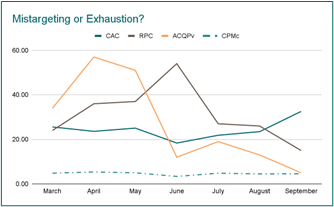
However, based on in-depth metrics observed through different brand channels, the brand payment growth rate has been extremely heterogeneous since March, reaching an all-time deviation of 73.84% between May and June.* These indicators demonstrate that since March 2025, the brand is acquiring more users with increasing costs and deviated ROI, a critical indicator of mistargeting.
The verdict? No channel exhaustion. Targeting is the most potential suspect for this deviation.
Mistargeting often mimics exhaustion. When targeting is off, digital algorithms try to “find” conversions by expanding the reach, which artificially inflates costs, making it look like the channel is exhausted. The fact that the growth rate has been “extremely heterogeneous” (unstable) since March 2025 suggests that the brand’s tracking pixels might be feeding the system low-quality data (GIGO – Garbage In Garbage Out).
When it comes to channel/content fatigue, the phenomenon is represented mainly through a supply-and-demand issue; brands have converted the “low-hanging fruit”, and to get more users, you must bid higher to reach people who are less interested. For digital marketers, the key symptoms are CPMs staying stable while CTR and CAC creep up linearly; as a painful grind that keeps burning through cash.
Mistargeting, on the other hand, is a “relevance” issue. The brand spends money in the right channel but on the wrong interest group (or the other way around). Key symptoms include high volatility in ROI; the algorithm receives noisy data, converting low-interest groups leading to a feedback loop of mistargeting.
On the graph demonstrated, all ROI-related metrics are highly heterogeneous, including RPC (recurrent profit coefficient) and ACQPv (acquisition pace value) while CPMc and CAC are highly stable, which clearly demonstrates an issue of mistargeting.
Superficial metrics, also known as vanity metrics, are the “fast food” of digital marketing: they’re easy to consume, they provide a quick hit of satisfaction, but they offer zero long-term nutritional value for a business. Those who stop at surface-level data are clearly burning budgets.
SHAPING THE TACTICAL EXPANSION MOVE
Superficial metrics, including CTR (Click-Through Rate) or CPC (Cost Per Click), can be incredibly misleading, a concept that we keep telling our clients. Brands can seamlessly have a 5% CTR and a $0.10 CPC, which looks like a massive win on a dashboard.
However, if those clicks are coming from a low-intent audience (brand tourists who click everything but will probably buy nothing), CAC will be astronomical. Relying on surface metrics allows brands to “efficiently” spend entire budgets on users who will never convert.
Here is exactly what makes performance marketing a competitive advantage for all brands whether on digital media or traditional ecosystems. Vanity metrics, often produced by the majority of platforms, only help you know “what” happened rather than “why” it happened. Performance marketers often understand the “delta” between leading KPIs and their lagging counterparts to architect a clear diagnosis of the brand-to-channel feedback loops.
Here is how we transformed these insights into a winning campaign.
1. Directives Driving the Rationale
The brand must operate on three levels of customer acquisition: (a) increasing the quality of customers, (b) increasing the quantity of customers, and (c) sorting customer contribution percentages to align value with impact.
2. The Rationale in Motion
The aforementioned directives shaped a clear rationale that explains vertical and horizontal expansion. In that context, it becomes imperative to find the right metrics that can reflect these changes as follows:
- Increasing the Quality of Paying Customers
The “quality” of paying customers is associated with three key factors (metrics): Trec (transaction recurrence), ATV (average transaction value), and ARPPU (average revenue per paying user).
- Increasing the Quantity of Paying Customers
In what concerns the quantity, it mainly revolves around ACQ Pace (acquisition pace), digital CAC, and PPR.
- Remapping Customer Contribution Percentages
88.72% of the total paying customers contribute to the total revenue pool with 31.43% while 10.13% of the total paying users contribute to the total revenue pool with 45.35%, and 1.1% of the total paying users contribute to the total revenue pool with 23.22%. In other words, ~90% of total paying customers are responsible only for ~32% of total revenue.
A customer contribution map that will generate incremental revenue if fixed.
3. Shaping the Campaign
We utilized a one-line copy that was short and straightforward. In that context, the campaign succeeded by matching the psychological preferences of the target audience.
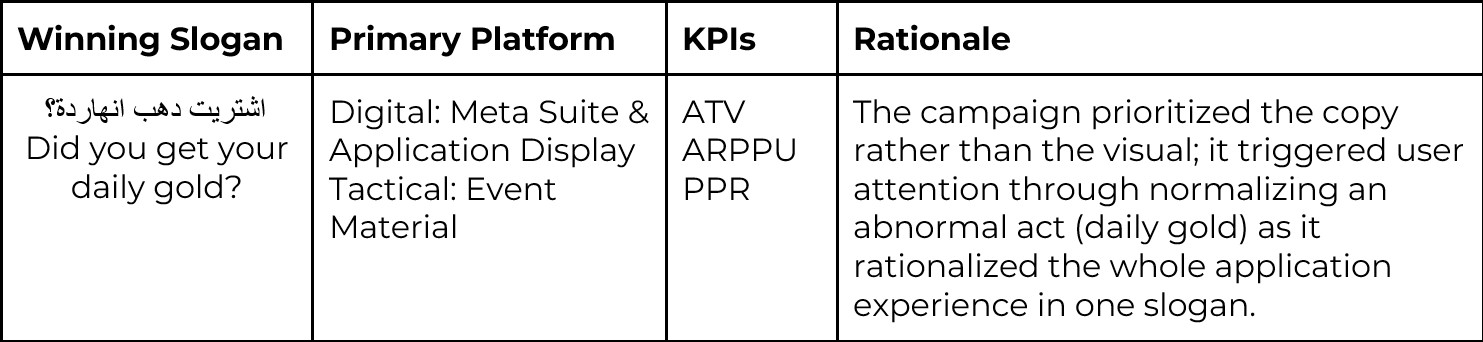
The creative assets were designed to align with the “native tendencies” of the platform they lived on, reducing the friction often caused by intrusive or over-produced advertising and balancing the intriguing nature of the slogan.
Rather than relying on vanity metrics, the campaign was “tightly associated with brand leading KPIs.” By focusing on hyper-targeting, the brand was able to turn a single line of copy into a 3-million-pound campaign, demonstrating that precision in targeting and relevance of message are more powerful than high-frequency, broad-reach tactics.
4. Key Results
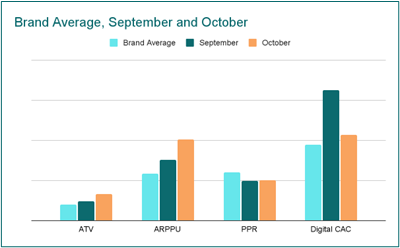
- ATV increased by 69.91% from the brand average to October.
- ARPPU increased by 93.17% from the brand average to October.
- PPR increased by 7.37% from the brand average to October.
- Digital CAC increased by 12.77% from the brand average to October but decreased by 34.35% from September.
CONCLUSIONS & STEPS FORWARD
The October Breakthrough campaign successfully validated the strategic directive to re-align the brand’s core messaging from “investment speculation” to “micro-saving security.” By utilizing a hyper-targeted, single-line copy—“Did you get your daily gold?”—that normalized the desired customer behavior (Trec – Transaction recurrence), the campaign fundamentally corrected the long-standing misalignment between the product’s psychological anchor (trust and stability) and its previous market communication.
Key Conclusions
- Alignment Validated: The significant increases in ATV (+69.91%) and ARPPU (+93.17%) prove that targeting a “saver mindset” audience even with a slightly higher Digital CAC (+12.77% from average) yields substantially higher quality, more valuable users. The sharp 34.35% decrease in CAC from September demonstrates that precision targeting immediately rectifies the cost inflation caused by mistargeting the wrong user segments.
- Quality Over Velocity: The modest but high-quality increase in PPR (+7.37%) confirms that prioritizing the quality of propagation (vertical expansion) is the correct path for sustainable growth. The brand is now acquiring users who are more likely to transact recurrently and with higher value, directly addressing the critical issue identified in the Customer Contribution Map (where 90% of users contributed only ~32% of revenue).
- Messaging is the Growth Engine: The campaign’s success confirms that the brand’s messaging architecture is a more potent variable for growth than channel saturation (no channel exhaustion was observed). The simple copy acted as a powerful filter, attracting high-intent users and filtering out speculative “trader mindset” clicks, thereby turning a single creative concept into a 3 -million campaign.
Steps Forward: Roadmap for Sustained Growth
Based on the validated strategy, the following steps are critical for long-term growth and diversification:
1. Vertical Expansion: Deepening Engagement and Value
- Systemic Copy Integration: Systematically integrate the proven “micro-saving” and “daily behavior” messaging across all brand touchpoints (onboarding, in-app notifications, retention emails) to reinforce the positive behavior (Trec).
- Targeted Retention Programs: Develop campaigns specifically aimed at the ~90% of low-contributing users to incrementally increase their ATV and Trec, maximizing value from the existing base before aggressive horizontal expansion.
- A/B Testing on Value: Continue A/B testing creative assets that lean into trust, security, and simplicity, moving further away from any imagery or language associated with “fast returns” or “speculation”.
2. Horizontal Expansion: Controlled Segmentation
- Segment-Based Diversification: Once vertical metrics are stable and optimized, begin controlled horizontal expansion into new, high-potential psychographic segments identified in the initial analysis, using the validated “micro-saving” language.
- Conceptualization: Begin R&D and conceptualization for new non-binding, micro-friendly products to build portfolio diversification and maintain a competitive edge against banks and fintechs, as recommended in the long-term strategy.
Ultimately, the October Breakthrough campaign serves as a powerful, data-backed testament to the non-negotiable importance of sophisticated Performance Marketing. It moves beyond the superficial lure of vanity metrics, demonstrating that genuine growth is not about generating cheap clicks, but about architecting a relevant feedback loop between the brand’s core value proposition and the customer’s intent.
By transforming a strategic insight into a single, high-leverage tactical copy, the campaign proved that precision in targeting and message alignment is the most effective growth engine. True performance marketing, as shown here, is the discipline of connecting psychological triggers with commercial objectives, turning a one-line slogan into a multi-million-pound result by relentlessly prioritizing the quality and lifetime value of every acquired user.